
The world of engagement rings can be a daunting place for newcomers. Whether you’re searching for a diamond ring for yourself or a loved one, you want it to be just right. But with some retailers offering over 400,000 variations of diamonds, where do you start?
Can’t tell your slightly included diamonds from your flawless round brilliants? We’re here to simplify things for you. There are three key considerations to take into account when picking your perfect diamond: colour, cut and clarity. These three things will largely dictate how you go about shopping for your engagement ring, with each element affecting both price and quality.
Colour
Rather counter-intuitively, when referring to the colour of diamonds, we are actually talking about the absence of colour. The Gemological Institute of America (GIA) grades diamonds for colour on a scale from D to Z, with D representing a colourless diamond, to Z signifying a diamond of light yellow or brown colour.
As the scale edges closer to grade D, the value of the diamond increases, as colourless diamonds are more rare and seen as most desirable. You can see examples of each grading on GIA’s website.
Many buyers who are new to the market can sometimes be misguided and place too much emphasis on buying the highest colour grade within their price range. However, there are many more factors you should take into consideration before splashing out on your colourless diamond. To the untrained eye, the differences between many colour grades will be indistinguishable, despite the drastic price jumps between them.
Arguably, other factors such as cut and clarity, are of more importance when it comes to finding your engagement ring. For instance, a very well cut diamond of a lower colour grade will likely look far better than a poorly cut diamond graded highly on the colour scale.

Image Source – Unsplash
Cut
Since different features of a diamond will be of varying importance to different customers, it is impossible to say which is the most important factor in determining quality. However, if you have your heart set on finding the ‘sparkliest’ diamond, then you should be paying close attention to the diamond’s cut.
At its simplest level, this element simply refers to how skillfully the diamond has been cut. GIA has developed another system to help categorise different cuts of diamond, with grades simply ranging from excellent to poor.
With the cut and shape of a diamond often being mistakenly interchanged, there are some distinct differences that are worth noting. Shape refers to the physical outline or form of a diamond, from popular round brilliants to the elegant princess. Meanwhile, as mentioned above, the cut simply refers to how well the diamond has been cut and faceted by a professional gemcutter.
This plays a key role in determining the overall finish of the diamond, affecting how much light is reflected and the amount of sparkle that is produced. In this way, you might consider choosing your desired shape first, and then determining how good a cut you can invest in, depending on your budget.
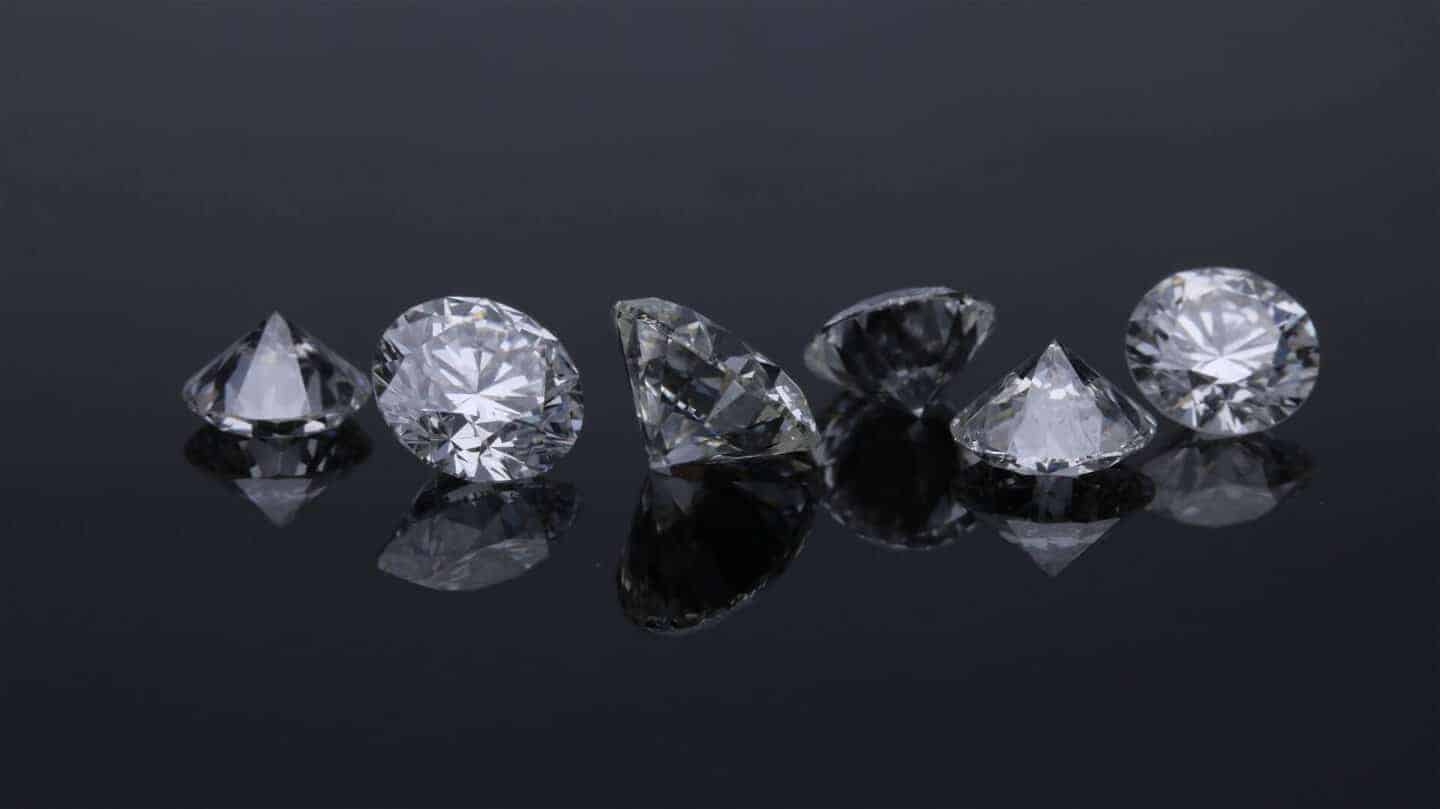
Image Source –Unsplash
Clarity
A diamond’s clarity concerns its visual appearance and is measured by the absence of inclusions and blemishes. When referring to diamonds, an inclusion is damage found inside the stone, altering its internal composition. Blemishes are external damage which can be sustained during the diamond’s formation, or after, usually during the cutting process.
The scale used to grade a diamond’s clarity ranges from flawless, where there are no blemishes or inclusions under 10x magnification, to included, where damage can affect transparency and brilliance.
As with each of the other factors affecting a diamond’s quality, clarity can significantly influence the price. However, similarly to colour, some differences in clarity grades are hardly noticeable to the naked eye, so make sure you shop around before opting for the best clarity in your budget.
Image Source – Unsplash