
The world of star maps is a fascinating convergence of human history, astronomy, and the deeply personal stories that we attach to the night sky.
These celestial charts have served as guides for ancient mariners, astronomers, and dreamers alike, mapping not only the positions of stars but the human imagination.
For millennia, humans have gazed at the night sky with wonder, curiosity, and reverence. The stars have held a profound place in our cultural, mythological, and scientific narratives.

The night sky has guided explorers, inspired artists, and sparked the imaginations of generations. It’s a timeless canvas upon which countless stories have been written, and star maps are our guides to unlocking those stories.
Glimpse into the Past: Star Mapping Across Ancient Civilizations
In the annals of history, stars and constellations were not just distant specks of light; they were guiding lights, crucial for navigation, agriculture, and timekeeping.
From the ancient mariners of Greece who relied on the North Star to the agricultural practices of the Mayans linked to the movement of celestial bodies, stars held utility and significance for countless civilizations.
Stars and constellations were not just utilitarian tools; they also found their place in the myths, stories, and beliefs of different cultures. Each civilization had its unique tales about the celestial objects they saw in the night sky, weaving cosmic narratives that often mirrored human experiences and beliefs.
By exploring these ancient cosmic stories, we gain a deeper understanding of how the night sky served as a canvas for human creativity and spirituality, and how these narratives are still encoded in star maps today.
The Astronomy Behind the Beauty: Unpacking the Science in Star Maps
When we gaze up at the night sky, we are not merely looking at a static and unchanging canvas of stars. The celestial canopy above us is a dynamic, ever-shifting panorama that has fascinated astronomers and stargazers for centuries.
Let’s delve into the complex and awe-inspiring phenomena that govern celestial movements.
- The Dance of the Planets: The first aspect of celestial movements that captures our attention is the wandering stars, or planets. The term “planet” is derived from the Greek word “planētēs,” which means “wanderer.” This name is apt, as planets appear to move against the background of fixed stars. This apparent motion is caused by the Earth’s orbit around the Sun, giving us a changing perspective on these neighboring worlds. Understanding the intricate choreography of the planets’ orbits is a fundamental part of astronomy.
- The Elegance of Ellipses: Johannes Kepler’s laws of planetary motion revolutionized our understanding of how celestial bodies move. One of his key insights was that planets orbit the Sun in elliptical paths, not perfect circles. These ellipses are characterized by two foci, with the Sun residing at one of them. This concept has profound implications for understanding the varying speeds at which planets travel in their orbits.
- The Clockwork of the Stars: The apparent nightly rotation of stars in the sky is a consequence of Earth’s rotation on its axis. This axis points roughly toward the North Star, Polaris, which appears stationary as the other stars revolve around it. This motion is responsible for the changing constellations that grace our skies throughout the year. The study of star positions and their apparent motion is known as astrometry, and it plays a vital role in producing accurate star maps.
How the Sky We See is a Window into the Cosmic Past
As we gaze up at the night sky, it’s essential to recognize that what we see is not a mere snapshot of the present but a portal to the distant past. The light that reaches us from stars and galaxies has journeyed across the cosmos, often for eons, before it finally reaches our eyes.
- The Time-Traveling Light: The immense distances in space are measured in light-years, a unit of measurement that reflects how far light travels in a single year. When we observe a star that is 100 light-years away, we are seeing the light it emitted a century ago. This means that the night sky is, in a way, a time machine that allows us to glimpse the universe’s history.
- Stellar Spectroscopy: A critical tool in unraveling the past of celestial objects is spectroscopy. This technique involves analyzing the light from stars and other objects, breaking it down into its constituent colors or spectra. By studying these spectra, astronomers can determine a star’s temperature, composition, and even its motion. This information provides valuable insights into the life cycle of stars and the evolution of galaxies.
- Galactic Archaeology: Beyond individual stars, the arrangement of stars in the night sky can tell us about the history and structure of our Milky Way galaxy. By studying the positions and motions of stars, astronomers can trace the history of galactic mergers, the birth and death of stars, and the overall structure of our cosmic neighborhood.
In summary, star maps offer not only aesthetic pleasure but a glimpse into the fascinating science of celestial movements and the history of the universe. Understanding the dynamic nature of the night sky and the temporal journey of its light enriches our appreciation of the beauty and complexity of the cosmos.

Personal Histories Engraved in the Stars
In our ever-evolving world, the stars above remain constant, a testament to the enduring nature of the cosmos. As we navigate the complexities of life on Earth, we often seek ways to connect with the past, celebrate the present, and leave our mark on the future.
Starry Constellations and Timeless Narratives
The night sky has always been a reflection of humanity’s collective history and a canvas for our individual stories. Custom star maps offer a unique way to capture a moment in time, whether it’s the night you met your soulmate, the birth of a child, or a cherished anniversary.
These bespoke celestial representations allow us to bridge the gap between past and present, by depicting the exact arrangement of stars on any date and from any location on Earth.
Personalized Celestial Snapshots
With advances in technology, custom star maps have become more accessible and customizable than ever before. Today, individuals can effortlessly create their own unique celestial artwork, featuring the precise alignment of stars and constellations as they appeared on their chosen date.
This level of personalization is not just an artistic endeavor; it’s a profound way to engrave special moments into the firmament.
Navigating Through the Cosmos of Memories
Our lives are a collection of memories and milestones, and custom star maps help us navigate through these cosmic memories. These maps serve as markers of time, allowing us to revisit and celebrate the events that have shaped our lives.
Whether it’s the first time you looked up at the night sky with wonder, or the night when you made a promise under a blanket of stars, these custom celestial charts hold the power to evoke emotions and cherish our unique journeys.
Connecting Generations through the Stars
Custom star maps also offer a bridge between generations. They allow us to share our stories with our children and grandchildren, giving them a tangible connection to the special moments that have defined our lives.
Passing down a custom star map becomes a symbol of our place in the universe and a reminder that we are all part of a greater cosmic narrative.
A Timeless Gift and Heirloom
Moreover, custom star maps make for extraordinary and meaningful gifts. Whether celebrating a wedding, commemorating a loved one’s life, or simply expressing gratitude, these personalized star charts offer a timeless and unforgettable gesture.
As heirlooms, they continue to remind future generations of the moments that have left an indelible mark on their family’s history.
In essence, custom star maps are more than just decorative pieces; they are gateways to the past, windows to the present, and anchors to our collective memory. They enable us to capture the cosmic canvas’s timeless beauty while leaving a lasting impression on the firmament, forever engraving our personal histories in the stars.

The Art and Evolution of Star Map Creations
The creation of star maps has a rich history that traces the evolution of human understanding of the cosmos and the technologies used to represent it.
From the earliest astrolabes to the modern era of digital printing, the art of star mapping has continually evolved, reflecting the changing relationship between humanity and the night sky.
From Ancient Astrolabes to Modern Digital Prints: The Evolution of Star Mapping
In antiquity, astronomers like Claudius Ptolemy meticulously cataloged the positions of stars and planets. The astrolabe, a sophisticated instrument, was used to create early star maps.
Ptolemaic traditions in star mapping relied on geocentric models, placing Earth at the center of the universe. Star maps represented this perspective, with constellations and celestial bodies drawn as they appeared from our planet.
The Copernican Revolution in the 16th century upended the geocentric view of the universe. With the sun as the new center of the solar system, star maps adapted to this heliocentric model. The works of Johannes Kepler and Tycho Brahe provided greater accuracy in tracking planetary movements, leading to more precise star maps.
With the development of telescopes and the advancement of space exploration, modern astronomy has access to incredibly detailed data about the night sky. This precision is reflected in contemporary star maps.
Digital technology has further revolutionized star mapping, making it possible to create custom, accurate, and highly detailed celestial charts. These can now be personalized to commemorate specific moments in an individual’s life.
Custom Star Maps: Where Traditional Astronomy Meets Contemporary Design
As we journey through the art and evolution of star mapping, we arrive at the contemporary intersection of traditional astronomy and cutting-edge design.
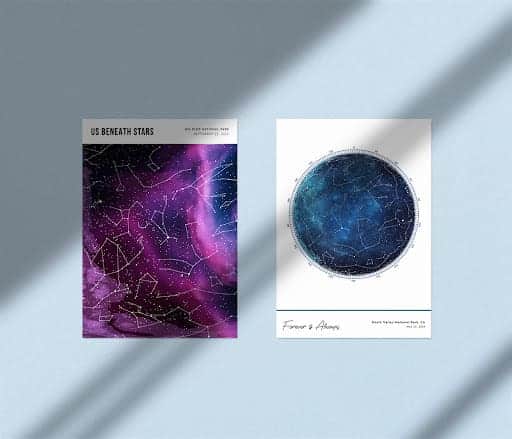
Custom star maps have become a bridge between ancient celestial traditions and the modern age, allowing individuals to create unique, personalized representations of the night sky.
Custom star maps blend the precision of astronomical data with modern design sensibilities. They offer a harmonious balance between science and art, allowing for visually stunning representations of the night sky.
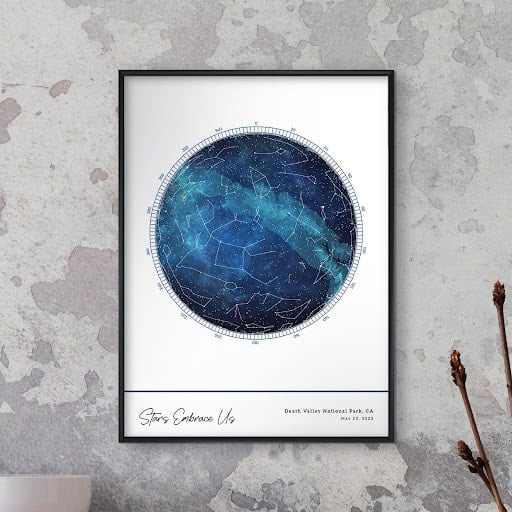
These maps enable individuals to select a specific date, time, and location to generate a star chart that holds deep personal meaning. Whether it’s an engagement, a birth, or a memorable anniversary, custom star maps capture these moments in a truly unique and artistic manner.
The popularity of custom star maps is on the rise, reflecting a growing interest in connecting with the cosmos in a personal way. This trend has given rise to a thriving market of artists, designers, and astronomers who collaborate to provide tailored celestial artwork.
Custom star maps have also become a thoughtful and meaningful gift choice. Whether given for a special occasion or as a token of appreciation, they provide recipients with a tangible connection to the celestial moment that has touched their lives.
In essence, custom star maps represent the convergence of ancient stargazing traditions and contemporary design, allowing us to celebrate our connection to the universe through personalized celestial narratives.
Star Maps in Literature and Popular Culture
Star maps and constellations have left an indelible mark on literature and film, weaving a celestial tapestry into the narrative fabric of countless stories.
Greek mythology, with its pantheon of gods and epic tales, has provided an enduring source of inspiration. Iconic constellations like Orion, Ursa Major, and Cassiopeia have made their way into modern works, and authors often draw upon these myths to infuse their stories with depth and symbolism.
For instance, Rick Riordan’s “Percy Jackson” series expertly blends Greek mythology with contemporary life, where the gods and their associated constellations guide the fates of young demigods.
The celestial realm has also been a wellspring of creativity in the realm of science fiction. Starships in franchises like “Star Trek” and “Star Wars” bear names that evoke a sense of cosmic adventure, inviting audiences to explore uncharted territories among the stars.
In J.K. Rowling’s “Harry Potter” series, even character names like Sirius Black pay homage to celestial bodies, adding layers of meaning and connecting the magical world to the night sky. These references serve not only to enrich the storytelling but also to tap into the human fascination with the mysteries of the cosmos.
Astronomical phenomena, from solar eclipses to the passage of comets, have held a timeless fascination for humanity, often being integrated into art and cultural narratives.
Solar and lunar eclipses have featured prominently in literature, such as Mark Twain’s “A Connecticut Yankee in King Arthur’s Court,” where they serve as catalysts for plot development.
Comets, historically seen as omens, have appeared in various works, including Shakespeare’s “Julius Caesar,” where the appearance of a comet foreshadows significant political changes.
These phenomena transcend mere astronomical events, becoming powerful symbols that shape characters’ beliefs and actions.
Exploring the Crafting of MixPlaces Star Maps
MixPlaces’ star map creations blend craftsmanship and artistry, demonstrating the precision behind these unique celestial mementos.
These exquisite maps go beyond aesthetics, representing a careful and intricate process that starts with accurate data collection of celestial positions and constellations for a specific date and location. The craftsmanship involves meticulous data processing, precise star and constellation alignment, and high-quality printing on premium materials.
The result is a personalized representation of the night sky, each map serving as a tangible and beautiful keepsake that captures a unique celestial moment with remarkable accuracy.
The artistry in MixPlaces’ star maps extends to their design, where a fusion of creativity and technical expertise comes into play. Graphic designers curate the stars and constellations, arranging them in a visually appealing layout and allowing for customization in colors, fonts, and messages.
This meticulous design process ensures that the final product faithfully recreates the night sky from the chosen date and location. As a result, MixPlaces’ star maps serve as a testament to the fusion of art and science, converting cherished memories into tangible and aesthetically stunning works of art.
While the craftsmanship and artistry behind MixPlaces’ star maps are impressive, what truly makes them special are the myriad personal experiences and stories they represent. These maps are not mere decorative pieces but personalized time capsules of unforgettable moments in people’s lives.
From the first date of a couple under a starry sky to the birth of a child, MixPlaces’ customers have shared their heartfelt experiences, making these star maps much more than art; they are a conduit for capturing and commemorating cherished moments.
These stories reveal the emotional power of MixPlaces’ creations, showcasing the versatility of these maps for various occasions, all united by the art of celestial representation and the everlasting memories they preserve.
Preserving the Night Sky: Addressing Light Pollution and the Importance of Dark Skies
The night sky, a celestial masterpiece that has inspired wonder and awe throughout human history, is facing an insidious threat – light pollution. The Dark Sky Movement, a global initiative, is at the forefront of raising awareness about this issue.
Light pollution, characterized by the excessive, misdirected, or intrusive artificial light, obscures the brilliance of our night skies, making it difficult to see the stars and celestial wonders. Beyond its impact on astronomers, light pollution disturbs the natural environment, ecosystems, and even human well-being.
With the relentless expansion of urban areas, artificial light spills into natural, rural landscapes, erasing the beauty of the starry night and disrupting the behavior of wildlife. This includes everything from disoriented birds colliding with buildings due to city lights to sea turtles drawn away from their nests by coastal illumination.
Moreover, excessive nighttime lighting has adverse effects on human health, interfering with sleep patterns and contributing to various health issues. The Dark Sky Movement is committed to highlighting the importance of preserving the night sky as a universal heritage.
This involves advocating for responsible lighting practices and encouraging communities to adopt energy-efficient and night-sky-friendly lighting technologies to mitigate light pollution.
The fight against light pollution is intrinsically linked to the conservation of biodiversity and ecosystems. Many species rely on the natural day-night cycles, and artificial lighting disrupts these vital rhythms.
For instance, sea turtles become disoriented by the glare of artificial lights, causing them to veer away from the ocean, resulting in nest loss and threatening their populations. Birds, especially during migration, can be drawn off course and collide with structures due to city lights.
To combat these issues, the Dark Sky Movement collaborates with environmental organizations to promote practical solutions.
Step-By-Step: How to Create and Optimize Your Personal Star Map
Creating your personalized star map is a unique and creative process, and understanding the customization options available is the first step.
Start by choosing a date and location that holds significance for you or the recipient of the star map. Whether it’s an anniversary, a birthday, or a memorable event, the date and place should have a special connection.
Next, explore the design options. Many star map services allow you to customize the colors, fonts, and background to make the map truly your own. Consider what aesthetic you want to achieve, whether it’s a classic look, a modern design, or something entirely unique.
Additionally, decide if you want to include a personalized message or quote on the star map. This can add a deeply personal touch and enhance the emotional value of the map. Once you’ve made these choices, proceed with the order, ensuring that all details are accurate.
To enhance the aesthetic and emotional value of your star map, consider the following tips:
- Select Meaningful Dates and Locations: The emotional resonance of your star map begins with the date and location you choose. Pick moments that hold sentimental value, like the day you met your partner or a loved one’s birthday.
- Choose Colors and Fonts Thoughtfully: Customization options for colors and fonts allow you to tailor the star map to your personal preferences. Consider colors that evoke the mood of the occasion, and fonts that reflect the style you desire.
- Include a Personal Message: Adding a personal message or quote can make your star map truly unique and heartfelt. It’s an opportunity to express your emotions and thoughts related to the event.
- Frame and Display: Once your star map is created, think about how you’ll display it. A well-chosen frame can complement the aesthetic of the map and make it a beautiful decor piece in your home.
- Gift with Intention: If you’re creating a star map as a gift, think about the recipient’s tastes and preferences. Tailor the design and message to suit their personality, making it an even more cherished present.
- Share the Story: Don’t forget to share the story behind the star map with the person receiving it. Explain the significance of the date and location and the emotions tied to the map, adding depth to the gift.
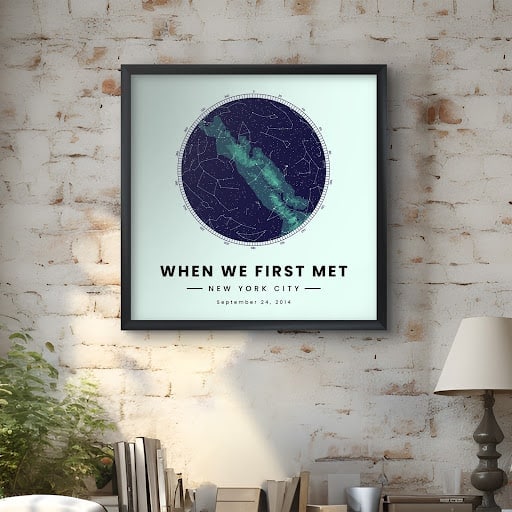
By carefully considering your customization options and paying attention to the emotional and aesthetic aspects, your personal star map will become a symbol of a meaningful moment, a unique work of art, and a thoughtful gift for yourself or a loved one.
Begin Your Starry Adventure
The night sky is a boundless canvas of wonder, and your celestial adventure awaits. Whether you’re an astronomy enthusiast or simply someone captivated by the beauty of the stars, it’s time to embark on your own stellar journey.
To commence your starry adventure, consider creating your own personalized star map with MixPlaces. Through their easy-to-use platform, you can craft a star map that encapsulates your most cherished moments and memories.
Select a date and location that hold special meaning, choose colors and fonts that resonate with your emotions, and add a personal message that captures the essence of the event.
Your star map will be a tangible link to the night sky, a piece of art, and a reflection of your unique celestial story. So, begin your journey today, and let the stars illuminate your path.