
Learning Japanese and memory often improve together. Each new word or pattern forces your brain to store, sort, and recall information on demand daily too.
Japanese adds extra pressure because it uses hiragana, katakana, and kanji. Switching between scripts trains attention, like changing gears while driving at speed in traffic.
That challenge can feel slow at first, but it builds stronger recall. You start noticing links, sounds, and meanings that stick longer over time naturally.

In this article, we will discuss how memory supports language learning, why Japanese writing tests recall, and what study routines help knowledge last for years.
How Memory Works in Language Acquisition
When you learn a language, your brain is doing two jobs at once: taking in new information and trying to store it in a way you can use later. At first, most of what you learn sits in short-term memory. That’s why you can recognise a new word during a lesson, but forget it the next day. Short-term memory is quick, but it’s also fragile. It needs repeated use before it becomes stable.
Long-term memory is where language skills really live. This is the part of memory that helps you remember how to form a sentence, what a word means, or how a sound should be pronounced. But long-term memory doesn’t build through exposure alone. It forms when the brain decides something is worth keeping. The fastest way to send that signal is by using the language, not just seeing it.
This is where recall matters. When you try to remember a word without looking, your brain strengthens the pathway to that memory. Even if you get it wrong, the effort helps. This is why simple habits like self-quizzing, writing from memory, or trying to speak without scripts can work better than rereading notes.
Context also plays a big role. A word learned in a meaningful sentence sticks more than a word learned in a list. The brain remembers stories, situations, and emotions more easily than isolated facts. So when language learning feels real, connected to your life, it becomes easier to remember and harder to lose.
Why Japanese Writing Systems Challenge Recall
Japanese can feel hard to remember at first because your brain has to switch between different types of writing in the same sentence. That switching slows reading down, and when reading is slow, recall often suffers too. You spend more effort decoding characters, so you have less attention left to understand the message. If you are constantly stopping to figure out what you are looking at, it is easier to forget what you just read.
Here’s the simple breakdown of the three scripts:
- Hiragana: a phonetic script used for grammar parts like particles and verb endings, so you see it all the time.
- Katakana: also phonetic, mainly used for loanwords and foreign names, which can feel unfamiliar in both sound and spelling.
- Kanji: characters that carry meaning, often with multiple readings, so you must remember shape, meaning, and context together.
Kanji is usually the biggest recall challenge because it is not a straight sound system. You cannot always “sound it out” the way you can in other languages. But the upside is that this difficulty builds stronger memory over time.
Once the scripts become familiar, reading speeds up, and your brain starts recognising patterns instead of translating everything step by step.
Vocabulary Retention in Japanese Learning
Vocabulary is often where Japanese learners feel memory gaps the most. You might recognise a word in a textbook, then blank on it the moment you try to use it in conversation.
That’s normal, because recognising and recalling are different skills. Recognition happens when the answer is in front of you. Recall is when you have to pull it from your brain with no help.
Japanese vocabulary can also be harder to hold onto because many words sound similar, and small changes in pronunciation can change meaning. On top of that, you may learn a word in kana first, then later meet it in kanji, which can make it feel like a “new” word again.
To make words stick, it helps to learn them with a simple hook:
- a short example sentence
- a common situation where you would actually say it
- a visual link, like the kanji meaning or a mental picture
The goal is to give your brain more than one path back to the word.
Long-Term Memory Formation Through Repetition
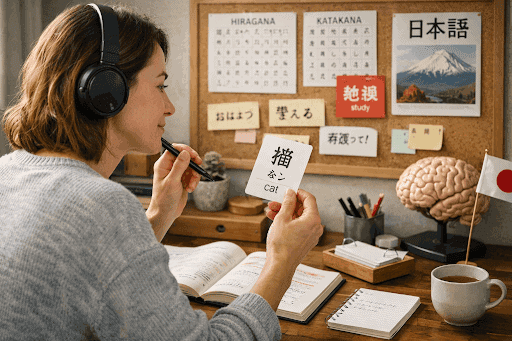
Long-term memory does not come from seeing a word once or twice. It comes from meeting the same word again and again, in different ways, over time. That is why Japanese learners often feel like they “know” a word one week, then lose it the next. The memory is still weak, so it fades when it is not used.
Repetition works best when it is spaced out. If you review a word today, then again tomorrow, then again a few days later, your brain starts treating it as important. It stops seeing it as short-term information and begins storing it for long-term use. This is also why small daily study tends to beat long weekend cram sessions.
What matters is not just repeating, but repeating with effort. If you always look at the answer first, you are not training recall. A better approach is to pause, try to remember, then check. That small struggle is what strengthens the memory.
For Japanese, repetition also needs variety. Seeing a word in a flashcard is helpful, but seeing it in a sentence, hearing it in a show, and using it in a message makes it stick much more.
Why Structured Language Learning Improves Recall
Structured learning helps because it removes guesswork and gives your brain a clear path to follow. When lessons build in the right order, you spend less time feeling lost and more time actually remembering.
Here are five simple reasons structured learning improves recall, broken down into clear points below.
1. Clear Progression Reduces Cognitive Load
When lessons follow a clear order, your brain does not have to guess what matters. You learn one building block, then stack the next on top.
This lowers mental strain and makes recall easier. In Japanese, this helps a lot because you are juggling new sounds, new symbols, and new sentence patterns at once.
2. Clear Progression Reduces Cognitive Load
When lessons come in the right order, your brain can relax a bit. You learn one small idea, use it, then add the next one.
That way, you are not trying to hold ten new things in your head at once. With Japanese, this matters because scripts and grammar can pile up fast if the steps are random.
3. Consistent Routines Help Memory Stick
Memory likes routine. If you study at the same time each day, even for 15 minutes, your brain starts to expect Japanese practice. That makes it easier to focus and easier to remember.
The small habit also keeps you from forgetting what you learnt last week, which is what happens when study is random.
4. Guided Review Prevents Forgetting
Most people forget new words because they never see them again at the right time. Structured programmes plan reviews on purpose, so important vocabulary and grammar return before you lose them.
A structured course can make this easier because review is built in and you do not have to guess what to revise, which is why Japanese language courses in Singapore can feel easier to stick with when consistency and recall matter.
5. Structured Practice Builds Confidence
When practice is organised, you are not just “doing exercises”. You are training the same skill in small steps until it feels normal. That steady build makes recall easier because you know what to reach for in your mind.
With Japanese, short drills on reading, listening, and sentence patterns can stop you from freezing when you need the words.
Conclusion
Learning Japanese is not just about adding a skill to your CV. It is regular brain training you can feel day to day.
The scripts, sounds, and word order make you pause, think, and recall. That extra effort is what strengthens memory.
Over time, learning Japanese and memory start to reinforce each other. You stop cramming and start remembering through use.
Keep your study structured, review a little, and practise in real sentences. If you stay consistent, recall will follow, and it will spill into other parts of life too in ways you notice when reading, working, or chatting online.