
The first few months of life are crucial because they mark a time when our systems are growing and developing. As a result, sensory baby toys buying guide have a special place in the development of each system.
Babies need sensory toys since their emotional development is still in its infancy. In the first several weeks of life, babies have few faint emotions. They will, however, start to exhibit and experience a more excellent range very soon and gradually develop these new sensations.

Beginning Sensory Stimulation in the Second Month of Life
Babies may focus their eyes on the human face in the early weeks of life. Even when inanimate items are incredibly vivid, they can’t have the same effect. Infants don’t begin turning their heads toward the sounds until the second month. Use sensory items to arouse your child’s senses during this time.
Since they engage a baby’s senses of sight, hearing, taste, smell, and touch, sensory toys are crucial. Babies are naturally curious, encouraging them to explore and learn freely, enabling their neural systems to form sensations and perceptions.
They learn a lot from the sensations and perceptions they pick up during the first year of life. They aid in the growth of crucial cognitive abilities, including memory and attention. Later, as babies grow, their brains do more advanced cognitive tasks. For instance, language and creativity are under this category.
As a mother, you should include sensory toys for babies in your child’s daily activities. These will enable the full development of your child’s sensory talents. Additionally, they improve kids’ cognitive intelligence.
How Should I Begin Baby Sensory?
Hold a toy in front of them to catch your baby’s attention while playing on their stomachs. Your baby will be encouraged to elevate their head and grab the toy if you do this. Toys arranged in a circle around your infant encourage reaching in various ways.
A Sensory Toy’s Purpose
A sensory toy has the purpose of arousing one or more senses. Children with autism can be more drawn to sensory toys since they can keep them quiet and give them the desired sensory experience.
You can improve children’s fine and gross motor and hand-eye coordination with sensory toys. Your children may explore and learn about their world through sensory play. It promotes the growth of their five senses playfully.
The Advantages of Sensory Toys for Babies
There is always more going on with sensory toys than is immediately apparent. In addition to being entertaining and engaging for infants and young children. Furthermore, by observing, formulating a hypothesis, conducting experiments, and drawing conclusions, these activities help kids employ the “scientific method.”
Children can improve their thresholds for various sensory information through sensory exercises, which also helps their brain build stronger connections to sensory input and learn which sensory information is helpful and which can be tuned out. For instance, when there is too much going on in their environment with conflicting sounds or images, a youngster may find it challenging to play with other children.
Using a sensory toy, the child can learn to tune out unimportant noises and concentrate on the sensory activity with their peer. Another illustration is a kid who has trouble eating spaghetti or other dishes with a moist texture.
The use of sensory toys can help the youngster explore touch, smell, and texture in a setting with few expectations. As the youngster gains confidence in and awareness of this texture, it helps create neural connections that signal to the brain that it is okay to interact with this food. Children naturally want to play with sensory toys, so parents and early learning facilities should support and promote this behavior.
Baby-Friendly Types of Sensory Toys
Here are a few ideas for babies’ sensory toys that are great for early stimulation:
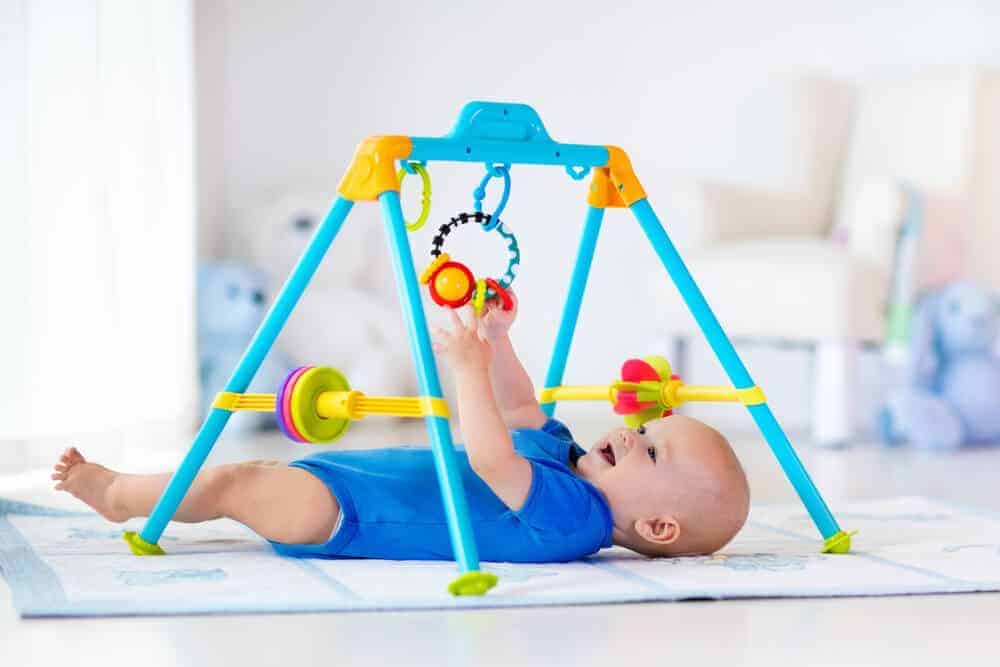
Activity Centers
Although there are several activity gyms on the market, you may also build your own. Create an arch or bar over a textured blanket on which you can attach colored things. Children will find the objects considerably more appealing if they contain sound, lighting, or fragrance.
Sandbags
Making these at home is quite simple. You can assemble vibrant cloth bags and fill them with sand from the beach or another comparable substance. Additionally, you can change things up by stuffing some bags with beans and others with seeds, etc. You’re done by sewing up the seams to complete the project!
Play Area Blankets
Babies can develop and experiment with new sensations on their own or in your company with activity blankets. Your infant will be more at ease when exploring if the blanket is thicker.
Slime
In this case, all that is needed is a small amount of water, cornstarch, and food coloring. Before adding any of the components to a dishpan, baby bathtub, or another shallow container, they should all be blended. Use just enough water to make the mixture thick and dense; avoid using too much.
Your kid will be able to sink into their hands and feet and feel new things because of the consequent constancy.
Colorful Spheres
Because of the variety of learning and stimulus they provide, colorful spheres are incredibly helpful. They are also therapeutic.
Can Babies Be Overstimulated?
Babies can overstimulate; that much is certain. They experience this when there are more activities, sounds, and sensations going on than they can handle.
What Can I Do To Raise My Baby’s IQ?
- Before birth, start your baby off right.
- Make more baby talk.
- Play hand-based video games.
- Pay attention.
- Encourage a young reader’s love of literature.
- Please encourage your child to embrace her own body.
- Pick toys that encourage interaction and exploration for infants.
- When your infant cries, take action right away.
It’s vital to note that before letting your infant play with any sensory toys, you should know the baby toys buying guide. The five senses must develop during the early stages of life. Children encounter an absorption process that improves learning thanks to how their feelings interact with movement. Children start to understand the world around them in this way.