
It is easier to embrace misery than to hope for happiness. Perhaps that’s why artists have been obsessed with devil and satanic paintings for the past five hundred years. He has many names: Ruler of Hell, Prince of Darkness, Lucifer, and The Devil. But his purpose remains one: bringing despair and damnation to those who wrong him. If you’re interested in oil paintings and want to start here’s a Guide To Using Oil Paints.
Since his emergence in the Middle Ages, Lucifer has been depicted as an evil, cloven-hoofed demon with fangs, horns, and a foul smell. The concept of Hell and its ruler has been derived from ancient mythology, the Bible, and literature. And as Western culture progressed, artists and intellectuals started to perceive the concept of Hell as a metaphor.
Satan also gained some sympathy, compelling people to see a more humanized incarnation of him. Nevertheless, some distressing Lucifer paintings have haunted people for the past five centuries. Let’s explore them, shall we?
The Last Judgment by Jan van Eyck

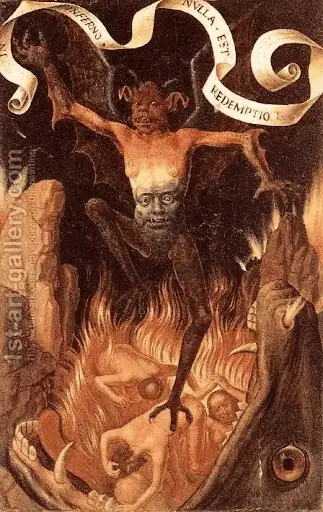
“The Last Judgement” by the Netherlandish artist Jan van Eyck is an oil Renaissance painting created between 1440-1441. It is painted on the right half of a diptych, the left panel illustrating the Crucifixion. Hell in this period was represented through menacing and barbaric compositions. Eyck has taken the same ominous path to depict Hell.
A giant, sinister skeleton is hovering over thousands of poor souls who are damned to Hell by the devil. Several garnish demons open their canines to swallow the humans while they writhe in agony. This rendition of Hell is hugely terrorizing. The curator of the Metropolitan Museum of Art described this painting as a “diabolical invention.”
The Nightmare by Henry Fuseli

“The Nightmare” by Anglo-Swiss artist Henry Fuseli is an oil artwork created in 1781.
There is an illustration of a woman dressed in a flowing white gown. Her arms, neck, and head are hanging off the edge of her bed in the painting. A frightening incubus is crouched on her chest, while a horse with gleaming eyes and flared nostrils peek from the dark background.
The incubus was said to be an evil spirit that haunted and sexually abused women in their sleep. It’s not clear whether the demon is tormenting the woman in reality or if it’s just a figment of her nightmare. Nonetheless, this satan painting opened the gates to many kinds of research on unconscious minds and dreams, so much so that the Austrian neurologist Sigmund Freud kept a copy of the artwork in his apartment.
Dante and Virgil in Hell by William-Adolphe Bouguereau
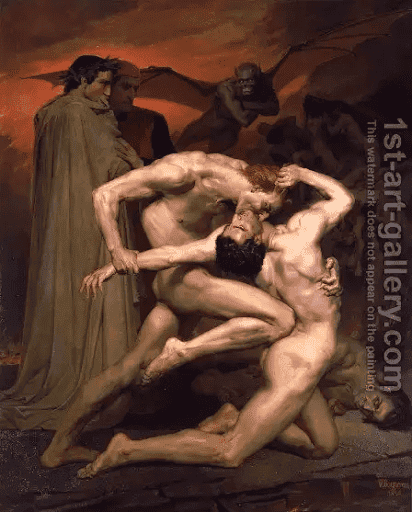
French painter William-Adolphe Bouguereau painted “Dante and Virgil in Hell” in 1850 in a desperate attempt to win the Prix du Rome. This famous demon artwork depicts a scene from the Inferno in Dante’s “Divine Comedy,” wherein Virgil, the Roman poet, guides Dante Alighieri as he walks the dangerous paths of Hell.
Along with other writhing sinners, they look over the combat that transpires between the two damned souls. Gianni Schicchi, who acquired a dead man’s inheritance through fraud, is biting and kneeling Capocchio, a heretic and alchemist. The ghastly demonic bat flies over them, waiting for their inevitable ruin.
Lucifer by Franz von Stuck
By the end of the 18th-century, the idea of sin changed, and so did its personification. This change was because of many revolutions that the world had faced. As Jean-Paul Sartre puts it, “Hell is other people.” Lucifer was no longer evil; instead, he became the prey of the evils.
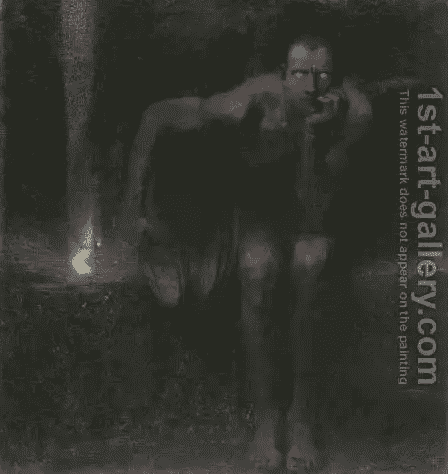
“Lucifer” was painted in 1890 by the German artist and founder of the Munich Secession, Franz von Stuck. This demon painting belonged to the “dark monumental” period and resorted to illustrate the devil as a “man-demon.”
The painting depicts Lucifer as a naked man, with his wings the only symbol of his demonic origin. He sits pensively with his chin tucked in his palm as white light glows from the tree base against the dark background. This demon art depicts Stuck’s belief in the complexity of human character and a grey concept rather than plain black and white.
Demon Seated by Mikhail Vrubel
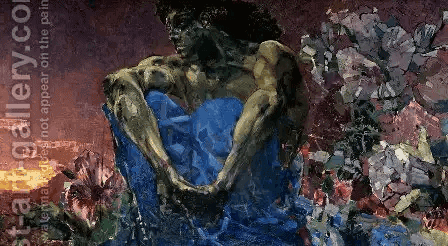
“Demon Seated” is a symbolist painting created by Russian artist Mikhail Vrubel in 1890. The demon of Vrubel’s artwork is based on the protagonist of a Romantic poem by Mikhail Lermontov. The Byronic devil loved a Georgian princess, who died due to his kiss. Consequently, the demon was fated to spend eternities alone.
His eyes reflect introspection as he stares into a reflective abyss. The background incorporates a sunset, fire, and giant flowers, depicting an alternative world. According to Vrubel, the demon is not cruel or in pain; instead, he possesses a majestic and noble spirit.
Conclusion
The baleful and depressing artworks of Hell and Satan have dominated history and cinema. Some of the most famous devil and Lucifer paintings are available at 1st Art Gallery, the largest supplier of Made-to-Order oil paintings. So gauge through the different artworks and decide for yourself if the devil manifests evil or just a misunderstood victim.
You may also like: