
But for many disabled and elderly people, stairs are much more than a barrier: they affect daily living. A house might have a bedroom upstairs; a school, its library on the first floor; a hospital may send you home, yet you can’t reach your own bathroom. These problems create stress, fear, and dependence on others.
Portable stair-climbing devices help remove these obstacles. They allow people to move between levels without building work or permanent changes. These tools support people in places they visit every day, not just at home.
Why Stairs Cause Real Difficulties
Something as simple as a single step can bar a wheelchair user from entering a shop, and a flight of stairs can get in the way of a person seeing family living on an upper floor. Lots of people try to solve this by lifting.
It feels like the quickest option, but it’s just not safe.
- Manual lifting is risky for both individuals involved.
- The helper can hurt their back.
- The person being lifted can lose balance or fall.
- Even strong carers struggle with stairs because the weight shifts suddenly.
UK moving and handling guidelines warn against lifting people on stairs for these reasons.
Fixed stairlifts are safer, but they only work in one place. They take time to install. They are not handy for someone who moves between homes, school, work, or hospital settings. Most renters also cannot make major changes to their property.
What Portable Stair Climbers Do
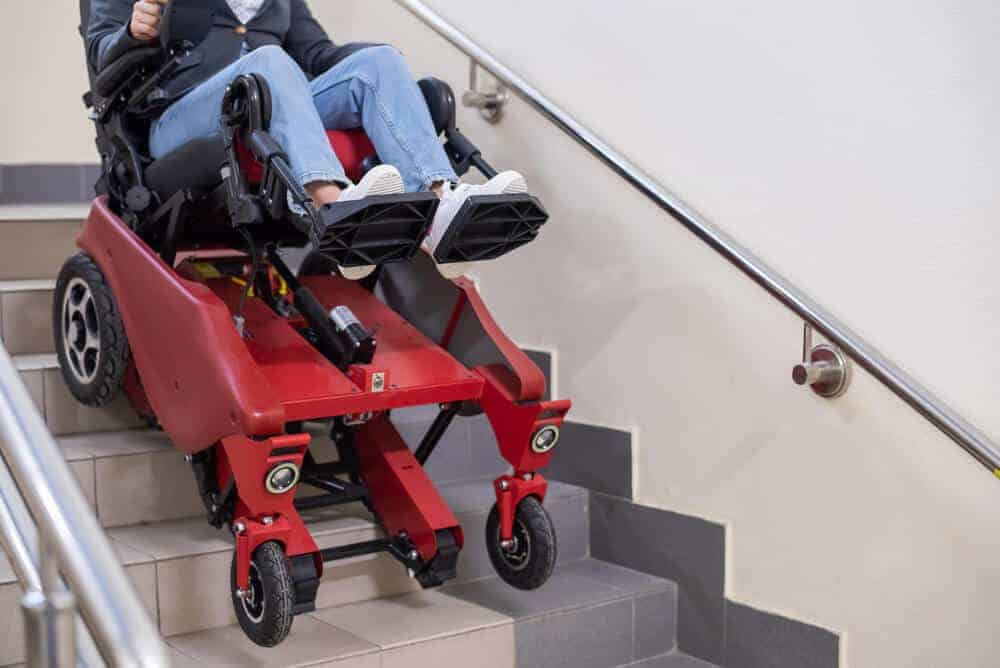
Portable stair climbers are designed to move a person up or down stairs in a controlled, powered manner. They do not attach to walls or rails. A trained helper guides the device while the user stays seated or in their wheelchair.
These devices are useful when the situations change.
- You can use them during brief recovery periods.
- You can take them to different locations.
- You can use these in homes, workplaces, and public buildings.
Common benefits include:
- They work on many stair designs.
- They don’t require installation.
- They reduce physical strain on carers.
- They support independent access to buildings.
Types of Portable Stair Climbers
There are mainly two kinds, each for different needs.
Seated Portable Stair Climbers
- These have their own seat.
- The client transfers into the seat with assistance.
- It is controlled by an operator who gives instructions to the unit.
They are useful for people who cannot stand on stairs, like:
- Older persons with weak leg strength
- Patients after hip or knee surgery
- Those users who do not use a wheelchair daily
They are also easier to store, since they are compact.
Wheelchair-Mounted Stair Climbers
- These attach to a manual wheelchair.
- The user is seated in their own chair.
- There is no transfer involved, which reduces stress and risk.
They are ideal for:
- Full-time wheelchair users
- Students moving between floors
- People working in buildings not having lifts
- Visits to older properties and historic places
They feel familiar because the person remains in his own seating position.
Practical, Real-Life Use Cases
In Family Homes
A family living in a terraced house may well have the bedrooms upstairs. The portable device enables a parent to assist their child in making their way up safely to their room. It means the child does not have to sleep in the living room or avoid their own toys and belongings.
For example, a couple ageing at home might have a bathroom upstairs. A portable stair climber would let one partner support the other. They can keep their routine without expensive building work.
School and Education Settings
A student in a wheelchair needs to access a first-floor science lab when the lift is broken or there isn’t one. The staff members can use a portable stair climber to take the student up to class, rather than having to adjust their timetable or exclude them.
Discharge from the Hospital
A stroke patient may be ready to go home, but the only issue is that home has stairs. Rather than wait to get permanent equipment installed, staff can devise a plan for safe access by using a portable device. This will avoid delays and ease the transition back into daily life.
Public Buildings
Many town halls, theatres, places of worship, and heritage sites have stairs. There are many that, for various reasons, including planning rules, are unable to provide lifts. Portable stair climbers make visits possible, enabling attendance at weddings, funerals, award ceremonies, concerts, and family events.
Modern portable equipment, like the mobile stairlift, offers a practical solution with no requirement for fixed installations to ensure stairs are negotiated safely.
Safety and Comfort
Portable stair climbers are based on a controlled, powered system. They travel slowly and keep their balance. Most machines are equipped with a safety lock, seat support, and an automatic brake. Once the operator stops depressing controls, the machine stops its motion.
It protects both the helper and the user.
It removes the need to lift.
It reduces falls.
It follows safer moving and handling guidance in care homes, hospitals, and home support settings.
Comfort is emotional as well as physical. When someone knows they can reach upstairs, they feel less trapped. Many people start doing simple things again: visiting relatives, attending clubs, or going back to work.
These may sound small, but they change daily life.
How They Compare to Traditional Stairlifts
Traditional stairlifts are great for long-term home use. They offer smooth rides. They require no operator once installed. They are fixed to the building. They take time and effort to install. They only work in one location.
Portable stair climbers focus on flexibility.
- They suit people who relocate frequently.
- They support schools, care teams, and hospitals.
- They help when the need for mobility changes or is temporary.
- They allow access without structural changes.
Both have a purpose. The difference is freedom.
Final Thoughts
Portable stair climbers are devices that facilitate mobility and help break barriers that many individuals face daily. They make stairs passable without having to undertake dangerous lifting or extensive, expensive modifications. They fit into real life, not planned environments.
These tools help disabled users connect to their homes, their communities, education, and care. They give carers a safer way to support others.
Most importantly, these devices give people the option to move with confidence wherever stairs may exist.
